






Scene Negotiation and How To Make A Safe Word

What is scene negotiation?
Simply put, scene negotiation is the conversation that needs to happen before a scene begins. This is where you can discuss the details of what it is that you’re interested in exploring or taking part in, and make sure that all expectations are aligned. This is where you can (and should!) state your needs, wants, boundaries, and curiosities.
The reason why scene negotiation should happen in advance is that when we are already beginning our scene, that active adrenaline in our arousal or excitement can cause us to barrel through negotiation with a mindset that may not be as clear and sound as it could be outside of the bedroom. If we’re raring to go, we can miss important information from our partner, or not properly share our own.
While we might believe that it may not feel super sexy to have a sit-down talk with a playmate before getting down to it, this conversation will not only help to prevent any negative experiences but can also make sure that we have time to craft a scene that’s going to give everyone the best and hottest possible experience. Think of it as conversational foreplay and let that sexy anticipation build!
What should you discuss during scene negotiation?
This is a time to set all expectations. What are you hoping this scene is going to include? Who will be involved, in what way? What kinds of play will we be doing (oral sex, penetration, bondage, impact play)? What safer sex practices are being used? What type of toys or sensations will we be exploring?
Especially for BDSM scenes, remember: our bodies are unique and nuanced, and so how sensation is experienced can (and often does) vary from person to person (for example, what feels like a light spank to one person may be too intense for another). Beyond this, BDSM often has emotional and mental elements to it as well as physical, so don’t forget to describe how you want the scene to feel in that regard – do you want it to be sensual and caring? Do you want to play with power dynamics that may be different from how your relationship usually feels?
During scene negotiation, the more detail that’s given, the better. If you're not sure where to start, a "Yes, No, Maybe" list can be an incredible tool to get the conversation going.
Discussing your desires
Negotiation is an opportunity to talk about what you want: interests, fantasies, curiosities, and things you’d love to explore so everyone has a chance to shape the scene around what sounds exciting to them. As much as we might wish we could read our partner’s mind, we can’t know what someone is into unless they tell us - so, the more you communicate up front, the easier it is to create an experience that feels good, safe, satisfying, and have the highest pleasure potential for everyone involved.
Wants: This is something that has been done before that there is a firm interest in doing again.
- I want you to use a vibrator on me.
- I’d like to be your submissive during this scene.
Curiosities: This is something that hasn’t been explored yet, but there is interest in trying.
Needs: This is something that is required for participation in the scene or activity.
- If you’re going to Dominate me, I need you to give me affirmations throughout.
- I need to be tied up to get into a submissive headspace.
Discussing your boundaries
Making space for everyone to share what’s off the table, what they’re unsure about, and what they need to feel comfortable is essential to any consensual experience. Just like we can't read someone's mind to know what they're into, we can’t know someone’s limits unless they tell us. Clear communication helps prevent misunderstandings and create a safe and consent-focused environment, making it easier for everyone to relax, stay present, and enjoy the experience.
Hard Limit: Also known as a boundary. This is something that is off the table for this scene (or always) and is not to be engaged in during the scene in any way. If a hard limit is disregarded, it is a violation of consent.
- I have a hard limit when it comes to hair pulling.
- I do not like having my feet touched.
- For this scene, I do not want to have penetrative sex – I want this to be bondage only.
Soft Limit: Unlike a hard limit, which is a strict and unwavering “no,” a soft limit is a boundary that may be open to exploration under specifically agreed circumstances. This requires in-depth conversation, detailed negotiation, and clear agreement about what is and isn’t okay before play begins. A soft limit might involve an activity someone has reservations about or a specific threshold within an activity that must be clearly defined and respected.
- I’m okay with being spanked, but not to the point of becoming bruised or marked.
- I don’t necessarily like being called names in bed, but if you want to try names that are not very harsh, like “naughty,” I might be okay with that.
Remember, consent to one thing isn't consent to everything.
Consent needs to be freely given (no coercion, no pressure, no guilt), retractable (you can change your mind at ANY time), informed (you know exactly what you are agreeing to), enthusiastic (it's a genuine yes, not just a maybe), and specific (particular to the activity, who's involved, and circumstances).
For a deeper dive on consent, check out our blog here.
What are safewords, and why are they so important?
During scene negotiation, an important decision to be made is the creation of a safeword that everyone involved will be familiar with. A safeword is a word (or sound or action) that conveys that a boundary has been reached or crossed, and acts as a way to let everyone in the scene know that play needs to be paused or stopped completely.
Think of a safeword as “no" or “stop,” or in some cases, “time out”.
Consent always has the ability to be retracted, and using a safeword does just that. Any play that continues after a safeword / safe action has been used is no longer consensual.
How to make a strong safeword
Safe words should be easy to say and easy to recognize. This means that you want your safeword to be easy to pronounce, easy to remember, and a word that can’t be confused with anything else that may be said as part of the scene.
For example:
If you are doing a pirate roleplay, “ship” may not be a distinct safeword.
If your partner’s name is Joanna, “banana” may not be a clear safeword.
Make your safeword something punchy – starting with a hard consonant sound is always a good option, as our sense of hearing tends to pick up on these sounds clearly.
Some ideas for safewords include: pineapple, jupiter, vanilla, ping-pong, mermaid, and the most popular: red.
Using the "stoplight method" for safe words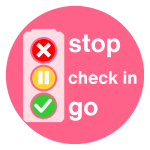
Safewords can also have levels to them – a very popular (and easy!) way to do this is the stoplight method, in which you use the colors of a traffic signal to let your partner know quickly and easily where you're at:
Green = yes / keep going / I'm ready
“Green” signals clear, enthusiastic consent. It lets your partner know that you’re enjoying yourself, and want to keep going. You can use it to reassure your partner that everything feels good, especially during intense or unfamiliar play, or to signal that you’re ready to continue after a pause.
Yellow = time out / pause / slow down (also means "we need a check-in")
If you don’t want play to stop entirely but need a break or want to change something, calling “yellow” signals that it’s time to pause and check in. It gives you and your partner a moment to make adjustments before continuing.
Red* = stop completely
Calling "red" signals that you need all play to end immediately and completely, no matter the reason. Consent can be withdrawn at any time, even if someone previously agreed to the activity.
*Anything that continues after “red” has been called is not consensual - which means there should be no questions, negotiation, or attempts to continue until the partner who called "red" expresses clearly that it is okay to do so. After stopping, take time to check in with your partner, make sure they’re okay, and understand what they need.
Why not just say "no" or "stop"?
Unless you’ve explicitly discussed and agreed otherwise, “no” and “stop” should always be treated as safewords / as a withdrawal of consent.
However, during some types of BDSM or kinky roleplay - especially scenes involving a strong power-exchange dynamic - words like “no” and “stop” may also come up as a consensual part of the fantasy. Without a defined safeword, this can make it unclear whether someone is staying in character or genuinely wants the scene to end.
For example, someone playing a submissive role might say, “No! I promise I’ve been good, please don’t spank me!” as part of the scene. In this context, the words are being used within the roleplay to further the scene, rather than as a withdrawal of consent.
A safeword gives everyone a clear, unmistakable signal that means “stop the scene” - no guessing required. It allows certain words to be part of the roleplay while giving everyone another clear way to communicate that consent has been withdrawn. Choose a safeword that’s easy to remember and unlikely to come up accidentally, and make sure everyone understands exactly what it means.
Remember: a safeword is not a replacement for paying attention to your partner. If you hear “no” or “stop” and aren’t completely sure whether it’s part of the roleplay or a genuine request to stop, pause the scene and check in.
What is a safe action?
Safe actions work like safewords, but they’re communicated nonverbally. They can be especially important when someone may not be able to clearly speak or hear a safeword during a scene.
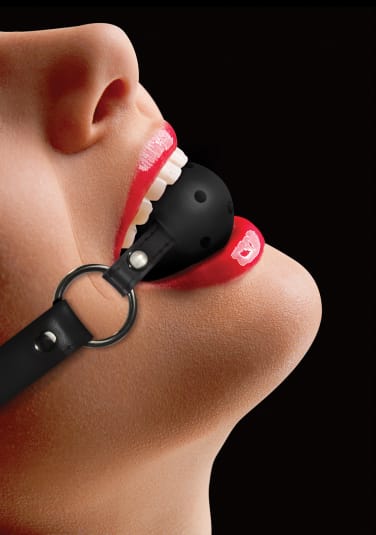
For example, a safe action can be useful if someone is wearing a ball gag, there’s loud music or other background noise, or a partner may become nonverbal or has difficulty hearing. In these situations, agree on a clear physical signal that means “stop” before play begins. Safe actions can be used instead of or alongside a safeword.
Some examples include: tapping your partner twice (“tapping out”), snapping your fingers, raising an open palm in a “stop” gesture, squeaking a toy*, or dropping a set of keys*.
*Make sure that if your safe action relies on a prop that it is always in hand, and that if the cue is still sound-based (like the squeaky toy), that it is able to be clearly heard.
Always take safe words and safe actions seriously.
Remember, safewords are serious, and should never be thrown around as a joke or ignored for any reason.
If you’re not sure if a safeword / safe action has been used – pause and check in clearly before continuing. It's important to keep communication flowing throughout play, and to pay attention to other signals that our bodies can provide, like body language or facial expressions. Again, if there's ever any uncertainty or if you think something might be off, always check in.
Don't forget aftercare
You want to take time to discuss and consider what happens after the scene, too. Aftercare is the time you take to physically and emotionally readjust after play, and it can look different for everyone. Maybe you want to be held, brought some water or a snack, or given a little extra reassurance after an intense scene. Maybe you need quiet time and space to yourself. There’s no one right way to do aftercare - what matters is knowing what helps you feel grounded and cared for.
If you already know what you need, talk about it during negotiation so your partner can help make it happen. If you’re not sure what you’ll need afterward, that’s okay, too - let your partner know you may need to figure it out in the moment, and give yourself space and permission to check in with your body and emotions once the scene is over. Planning for aftercare ahead of time helps make sure the care and communication don’t end when the scene does.
Go forth, communicate, and set the scene for pleasure :)